

At least I seem to be on the right side of an average.
Substack has launched Pangram, an AI powered tool that claims to detect, with 99% accuracy, whether a piece of text was written by a human or by AI. It sorts your writing into three buckets: human, ChatGPT-esque, or Claude-sounding.
I ran it on three random paragraphs from a handful of my articles. It scored me 100% human the first time, 100% AI the second, and 100% human again on the third. By then I had rather lost interest, realised I was only part synthetic, and decided I was fine with that.
On one hand, I fully understood Chris Best’s sentiment behind the war on slop. On the other hand, like Reddit and a good many others, I found it quietly ironic that the weapon of choice against AI was another AI powered tool.
Optimisation will be OK; Creativity remains controversial
Most leaders, some employees and definitely most investors, see the value in AI for optimisation, even where that value is still latent and has not quite materialised. Don’t worry, it will. Creativity is where the agreement ends and the spectrum runs wide.
And the debate could not be more concrete. Coca-Cola ran an AI-generated Christmas ad two years running, doubling down the second time despite the first having been widely panned and the industry kept talking about it until summer. Cannes Lions, saw award entries drop by more than a quarter, after a 2025 scandal in which a Grand Prix was revoked for AI-manipulated footage, that made mandatory AI disclosure and detection tools. A festival losing seven thousand entries the moment it asked people to declare their AI use tells you something about how much was quietly going unspoken.
Is it acceptable to write with AI, or only to edit with it? To use it for production, or to let it reach the concept? It has been a long time since I saw this much genuine debate about anything.
My question underneath it is this: what is it right to use AI for, in what capacity, and most importantly, who gets to decide?
AI made writing better, and samier
AI made a great deal of creativity online better and made it more of the same. Writers who have made a living from the craft for years reacted strongly against text they suspected was machine-written.
In January I wrote a piece for MAD//Fest titled “Would you know, and care, if ChatGPT wrote your birthday card?” It caused a small riot. I did not write it for the clicks, but to find out whether the sentiment would beat the craft. Craft won, thirty to seventy.
Does that mean I am not disappointed when I click an intriguing title and the first line opens with “it’s not X, it’s Y”? It does not. Does it mean I stop reading if the piece covers something I am genuinely interested in? Also no. That article was prompted, shaped and approved by an author who, one hopes, cares about what they choose to publish.
What AI actually did for me
Without AI, you would not be reading this. Not because I wrote it with AI, but because I would never have found the confidence to press publish, or the time to research the old school way.
As a child, writing carried me through the school system with good grades despite being an undiagnosed dyslexic with, I suspect, a few ADHD traits tagging along too. Writing, philosophy and theoretical physics pulled my average up. Algebra and anything too rigidly linear dragged it down. I left Italy at seventeen and picked up French and English along the way, working up to an executive role in London. My English writing became competent but very technical, very corporate, prose in a PowerPoint bullet. With AI I found the courage to attempt non-fiction again, and I liked the result.
AI never writes my work yet I write my text in a moltitude of ways. Sometimes at my laptop in the garden, as today. Other times I write chunks by hand on A4, knowing that four and a half pages of my handwriting come to roughly a thousand words, then photograph them, drop them into Claude, and ask it to suggest structural improvements and type them up.
And here is where it became genuinely useful, and deeply meaningful. Using AI forced me to ask radical questions about my own voice. Not what it was, as I have always known that, but which of the things I learned along the way I actually wanted to keep and which I wanted to reject. I learned to write in Italy, where the em-dash was never explained to me, so I never knew it existed until AI-generated content arrived. I understand now what it does, and how useful it can be yet I actively choose not to use it, because it is not part of how I learned to write. That choice is intuition in the service of authenticity, applied to my own craft, the same trained instinct this whole series is about, pointed inward.
It has produced some odd moments. When I pushed back on being edited into short, staccato sentences, Claude told me I had “a more European style,” and I confess I didn’t know how to feel about that. What did that mean, exactly? That declining to write in clipped, anxious little fragments made me somehow more European? And the best came from a senior Italian friend, also working in London, to whom I returned his own newsletter with a gentle note about a spelling mistake. Do not worry, he said, he was seeding those in, because people had started telling him his newsletters read as though they were AI-generated - which I thought they were anyway. All those years as a dyslexic Italian chasing decent English spelling (or decent spelling in any language, for that matter) to climb up the marketing ladder, and now the errors were the alibi. Something in me staged a small rebellion.
The tools prefer human work anyway
I do not fully understand the use of the detector, beyond earning twenty dollars and up from those who really need to know whether a machine had a hand in a piece. To me, an original idea, even if only so-so written, even with the occasional em-dash AI giveaway, is worth reading.
Lean on AI too heavily and you pay for it in reach. Graphite now puts primarily AI-generated articles at roughly half of everything newly published in English, and the machines do not appear to enjoy reading their own work, since 82% of what ChatGPT and Perplexity actually cite is human-written.
Poor find-ability is a price I can live with. What I am less sure about is software telling me to change how I write, or to lean less on the tools that get my ideas out.
There may be edge cases where I change my mind yet so far, the clear winner looks like Pangram’s shareholders to me.
The real risk
Not quite what the detectors are looking for but what my very good friend Nick Bailey wisely said: “The problem isn’t people using AI and passing it off as their own work. It’s people not using AI and sounding like they have, because that’s what they think good writing is.”
That is the thing to watch. AI is changing how we write en masse, and, faster and more strangely, how we speak. I have never noticed as sharply as in the last few months how many people around me have started saying “landed” or “this is the whole point.”
So. If you were an average five and AI brings you to a six, so be it. Keep your ideas your own, and stay true to the point of view you want to bring to the world, even if the words are AI-assisted. If you were a seven or above, like Nick, you have nothing to fear, because there will always be a market for you.
The founders of Pangram will make their money, since a witch hunt has always been good business for the hunters.
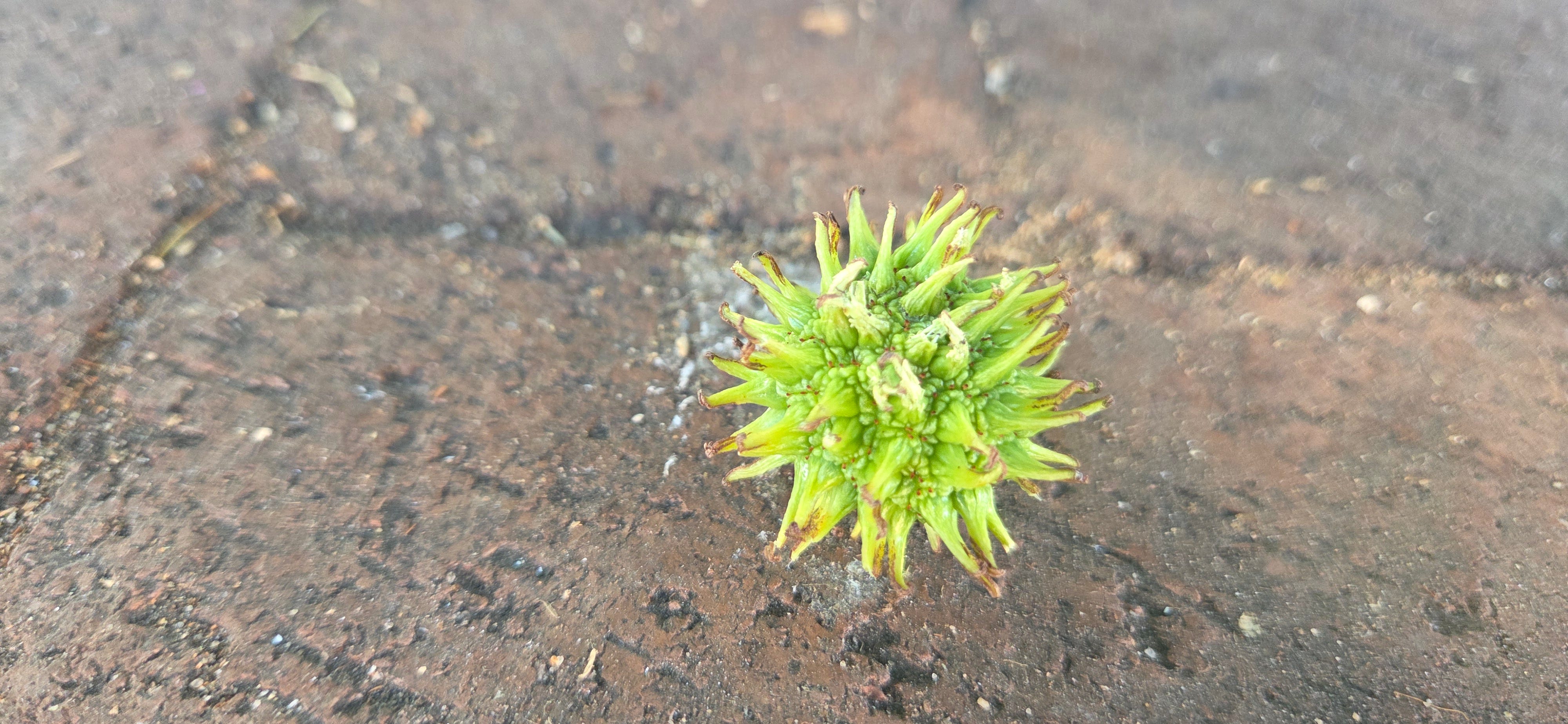
But I see something better in this spiky, uneven world where the natural and the synthetic sit side by side, like the strange green ball I photographed on a concrete pavement on my way home.
If you care about what you write, and the intent and the ideas are yours, use AI to take your words to a homogeneous six. It is better than what the internet used to be. And if your ideas are interesting, I will still read you.
What’s next
Out of my own head and into the room. How to use AI as one member of a curated team, how to run sessions where human intuition and machine output sharpen each other rather than blur into the same six, and why the team that argues well beats the individual with the best prompt.
If you found this useful, share it with the most splendid human writer you know. Or with the one who was bad and quietly became rather good, yet now reads like ChatGPT. Or with the one seeding spelling mistakes to prove they are still real, if you happen to know one. I suspect you do.
The more AI becomes mainstream, the more humanity and authenticity will be pertinent and shine through.
"And if your ideas are interesting, I will still read you" is so well said.
Thank You for sharing and glad to come across your page.