


Yes, I did go hunting for a bug, or a scarrafone, in every room of my garden in Puglia, and I finally found this one. Yes, I am keen to keep using my own photography as much as I can throughout my posts.
But the inspiration for this piece did not come from a bug, it came from a conversation with a very smart friend who told me recently that she had taken to running her thinking past AI because it was less biased than the people around her, and at that point I could not refrain from preaching at her more vehemently than a Jehovah's Witness on a doorstep.
If you have been reading me you will know by now that I find machines incredibly useful, able to synthesise, retrieve, create and model from known data at a volume and speed none of us had before. They have even helped me become clearer in my own strategies and voice, through the slow process of rejecting the alternatives they offered and working out, each time, exactly what it was that I did not like. They have saved me hundreds of hours on board packs, research and analysis. And they are incredibly biased, as is everyone else around you, which is a subject big enough that I am giving it a piece of its own next week.
AI As Your Counsellor
I paused for a meaningful while as I was choosing the word counsellor in the section title just now. I could have picked advisor, or tool, or even companion. Yet I settled on counsellor, which in my view carries technical and emotional value in equal measure, and a counsellor is confidential. Nobody else is in the room, nothing is written down where anyone can see it, and no colleague ever finds out what you asked.
We have been using AI in an intimate, private way. Perhaps when you asked ChatGPT “what does EBIDTA mean” rather than asking your Finance Director. Or when you spent twenty minutes of back and forth seeking emotional reassurance that no, your boss is not cross with you because of the way she phrased that email, and yes, you do sound a little defensive in the way you have formulated your reply, and no, you are not overreacting. Or, worst of all, when you asked whether your idea was any good before sharing it with a colleague, in fear of somebody repeating it or, worse still, passing it off as their own. Your team might never get to see that idea.
Why We Started Asking A Machine Instead
The reasons range from fear, to shame to a real or perceived lack of emotional safety, in a world that is going slightly wonky and where AI is genuinely taking jobs.
Challenger, Gray and Christmas attribute 101,743 job cuts in the first half of this year to AI alone, and a Harris Poll survey for Express Employment Professionals found last year that seventy-three per cent of job seekers believe no job is safe regardless of how well the person does it, with sixty-seven per cent saying they used to feel stable in their careers and no longer do. Sarah Wilson has just written a whole book, I Eat the Stars, about how to live fully in a world that is quietly coming apart, and it is top of my summer reading list. Whether or not you accept her diagnosis, the feeling she describes is the one people are carrying into the office every morning. We run to AI for a great many of the answers, and in most cases that works perfectly well. In others it costs us an opportunity we never find out about, or at worst it starts to erode the very capabilities we are relying on, because we do not integrate what we received with our own intuition or, most importantly, with the collective, which is where the next piece goes.
This one is to share a couple of dynamics I have watched form in rooms over the last year or so that deserve noting, so that we can move forward positively and with intent.
1. Hurray, I Can Do This With AI Now And I Don’t Need You (Designer, Engineer, Lawyer) Anymore
I have come up with a hypothesis that took inspiration to the Buffett and Munger circle of competence, just that I imagine the circle having more rings outside it. Towards the centre there is what you know really really well, or your area of expertise if you like, and as you move out it is what you are less of an expert of, until you reach the boundaries and meet vaguer and vaguer notions of the topics at hand. The size of your inner circle of competence does not matter. Knowing where its boundary is very much does. Sometimes good friends and colleagues can help you assess it.
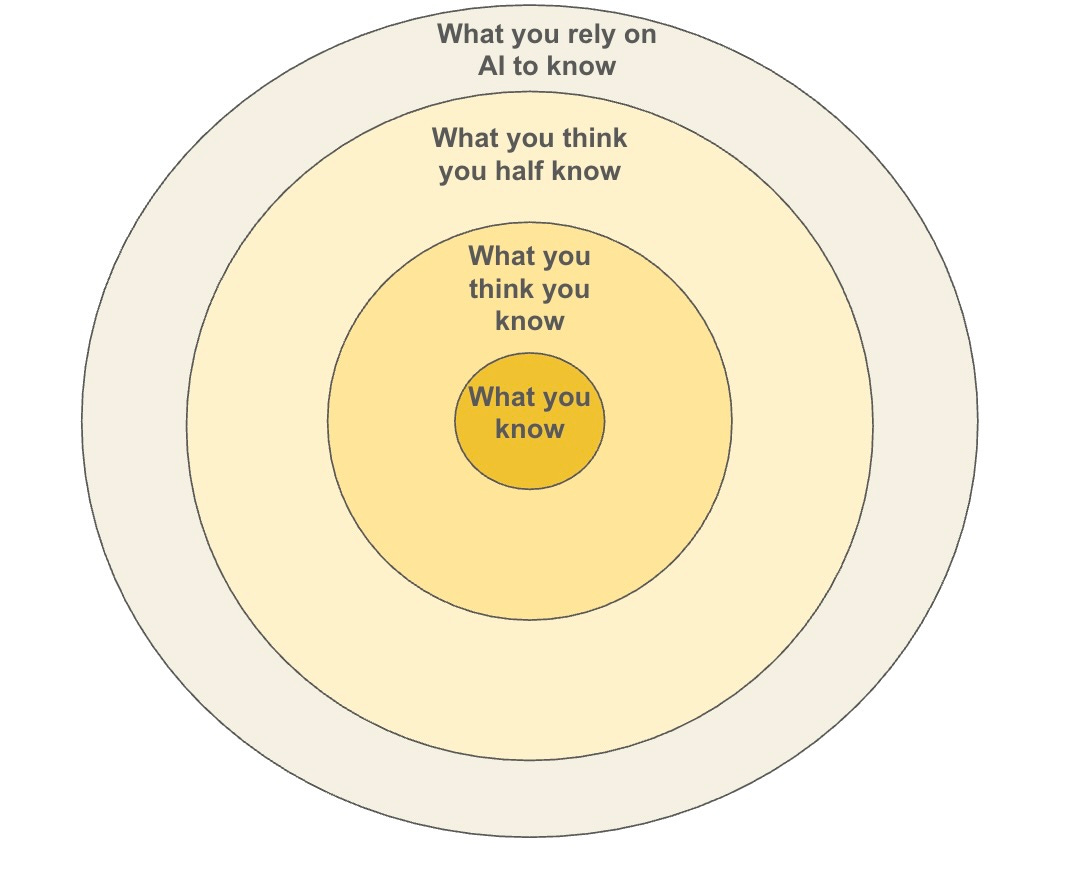
How much it matters that you cannot tell what good looks like depends entirely on the context and the risk carried with it. As a way of direct example, I made the diagram above myself, in about the time it would have taken me to brief somebody. A designer would look at it and see a dozen choices I did not know I was making, and would probably have made better ones. I looked at it and saw four rings doing the job, which tells you something about where the boundary of my own circle sits, and I decided the twenty minutes I saved were better spent on the words.
On a more serious note, two friends of mine negotiated redundancy settlements last year. Both of them ran the process primarily with AI. One came out of it with the most impressive outcome I have ever seen anybody achieve in such a settlement, and the other missed a big opportunity after almost two decades of employment.
They were using much the same tool. One of them had spent years inside commercial negotiations and had exited a couple of companies already, so she could feel where the advice was going thin. The other had never done any of it before.
Telling apart intuition from noise is something I covered in [The Two Conditions That Decide If Your Intuition Is Right]. Your signal is only worth trusting in a domain regular enough to have patterns in it, and only if you have had honest feedback on your judgements often enough to have been corrected. AI output can only be judged if you have enough experience to discern if it is good enough or not, and when it perhaps doesn’t matter.
2. I Am More Right Than Ever
The second dynamic is more annoying and more damaging. AI allows you to barricade yourself inside your own conviction, supported by data and a history trail that it was simply not possible to keep track of before. You arrive with a position, you ask a question shaped by that position, and back comes a beautifully organised case for the thing you already believed, with footnotes you can now annoy everybody else with.
I wrote about the antidote in When Did You Last Change Your Mind On Purpose?, and I am well aware that recommending open-mindedness is easy while actually start practicing can be quite hard. You can start from here. Before you go looking for support, write down what would have to be true for you to be wrong, and go asking for that instead.
3. Thirty Seconds To Get An Answer = Thirty Seconds To Decide
The tempo of the tool becomes the tempo you feel you have to match with your judgement. An answer that would have taken a week to assemble now arrives while you are still pondering whether you should have added that extra bit of context to the question, and the gap where the signal used to form quietly disappears.
I have written before about what a possum taught me about thinking, and the short version is that the pause was doing something. You can keep the speed, by all means, and yet not feel pressured into deciding today.
4. I Made This, And I Made It Before I Could
Which brings me to the scarrafone. In Naples they say “ogni scarrafone è bello a mamma soja”, every cockroach is beautiful to its own mother, and I have never found a better description of what happens when somebody produces an artefact they could not have produced alone a year ago.
There is proper science underneath the proverb. Norton, Mochon and Ariely gave it a name in 2012, the IKEA effect, and across four studies of people assembling flat-pack boxes, folding origami and building Lego, participants valued their own amateurish creations at roughly what they would pay for an expert’s work, and fully expected everybody else to agree with them. The detail that fascinated me is the boundary condition: the effect only appears when the task is completed successfully, and it disappears entirely when the creation fails or is left unfinished.
Sit with that for a moment in the context of a machine that completes every single task you give it, on the first attempt, most times in a presentable format. We are building a pretty efficient manufacturing process for the IKEA effect. You are proud of having made something that was out of your reach a year ago, and so you should be. What that pride does not tell you is whether the thing is any good.
Couple that with my first point and you are building some real blind spots.
So What To Do
Start with an honest assessment of your own competencies and capabilities. Have you done enough of this particular thing, and received enough active feedback on it, to know when good enough is genuinely good enough and when it is not?
Then ask the trusted people around you, which sounds obvious and is something we do less and less of, because the whole appeal of the AI counsellor was that nobody had to know.
More on the personal mini board, and how to assemble one worth having, is coming. In the meantime, be radically open minded about whatever comes back at you, and let it shape the next iteration rather than the defence of the last one.
What’s Next
How I use AI as one member of a curated team, how to make our biases an asset, and why the team that argues well beats the individual with the best prompt.
Send this to somebody who has recently made something they are very proud of, and be gentle about it. Every scarrafone deserves at least one honest reader, which brings me to my own. This piece has had two beta readers, my husband and Claude, one of whom is contractually devoted to me and the other of which is trained to tell me I am great. So please do tell me if it is part rubbish. I don’t like blind spots.
Published every Monday.
Love this sentence: “The tempo of the tool becomes the tempo you feel you have to match with your judgement.”
I’m not sure AI versus humans is the real discussion. The value of another mind - human or AI - isn’t necessarily that it is unbiased. Is there even such a thing as an unbiased mind? The value can be that it contributes something outside your own thinking.
What you do with that then becomes the issue. Do you accept it? Question it? Challenge it? Ask it to validate what you already decided?
My own response to AI is often: “No, that’s not it / not quite right.” Then I have to articulate why. The correction itself sharpens my thinking.
Humans and AI can both become echo chambers. It depends partly on who or what we surround ourselves with, but also on what we ask of them. My AI agents are explicitly instructed to leave out the cheerleading unless it is earned.
I would add one thing on intuition too: I don’t experience gut feeling and intuition as the same thing, and I don’t think all internal signals depend on previous patterns. We already touched on that in one of your previous articles.,but I think it matters here because it affects how we judge what AI can and cannot help us evaluate.
Such an interesting topic, and I think there’s much more to explore here. Because ultimately this may be less about our relationship with AI than our relationship with ourselves. If we were already used to outsourcing our judgement to other people, why would that necessarily change with AI?
In the end, whether it’s AI or another human, it comes down to how much we trust ourselves and our own judgement, particularly when someone or something disagrees with us. Use both to expand your thinking. But don’t outsource your judgement.