

If you have read a few of my pieces, you already know where the next paragraph is going, so skim ahead with my blessing. But do stay, because this piece is practical, simple, and easy to keep in your head when you actually need it.
Your body reaches a verdict before your mind has finished reading the evidence. You walk out of a meeting that went well on paper and something sits wrong in your chest. A deal everyone is celebrating leaves you faintly cold or oddly uncomfortable. A hire who ticks every box gives you a flicker of doubt you cannot quite articulate. All of it is information being served to you, and most of us have been trained to ignore it in favour of the spreadsheet and the slide deck.
Last week I set out the two conditions that decide whether a signal is worth trusting: a world regular enough to hold a real pattern, and enough honest feedback to have learned it. This week is about what to do once a signal arrives. How to read a red flag from a green light, and how to act when your gut and your data fall out with each other.
The green light I followed.
Years ago, working with Fiat, I had a hunch. Give people a simple way to see their environmental impact as they drove, in real time, and they would change how they drove, gentler on the planet and on their wallet, saving fuel just as a recession was closing in. The hunch did not come from a dashboard, and it was certainly not mine alone. It grew out of a series of conversations with Luis, an enlightened client who had a hunch of his own: that Fiat’s Blue&Me platform, the Microsoft system built into a large share of cars already on the road, and used mainly for safety, could do much more. I still remember him talking to me about music and in-car entertainment. It was 2007.
It became eco:Drive, and it went on to win a Grand Prix at Cannes Lions, a CNET award and a Gold at the Clios, then rolled out across seventeen markets. It is not about the trophies, but about the fact that the intuition arrived before the evidence. The timing was right, people were ready, and the data caught up to confirm what the signal already knew. That is a green light: gut and evidence pointing the same way.
Eco:Drive taught me to trust the signal. Which is exactly how, a few years later, I came to ignore one.
The red flag I overrode.
Then there was Opnuu, my peer-to-peer fashion lending marketplace. It came from the same place as Eco:Drive: a read on the circular economy and its promise of something better for the planet and the wallet at once. And it came from a kinship with another Livia, a Brazilian who loved sharing her frocks as much as I did. I sat in a meeting with a well-known VC who went through the pitch and found no fault in the model or the execution. The closed beta results were strong yet, disappointingly, something bothered him enough to keep his chequebook firmly shut.
‘Why is there no directly comparable peer-to-peer fashion platform in the US?’ he asked.
I didn’t know why, but I was steaming. I decided he was being narrow, mistaking caution for territory bias. Americans were already using Airbnb, TaskRabbit and Bag Borrow or Steal without blinking. Close enough, surely, to count as proof that Europe was ready too.
What in fact was happening was that he was telling me something I did not want to hear. If the US, usually ahead of Europe on peer-to-peer adoption, had not produced this model yet, the market might not be ready. I dropped the warning, raised what I could, and pushed on. I had to shut it down a couple of years later for lack of funding.
Here is the part that took me years to make peace with. My instinct was right: peer-to-peer fashion rental became a real category, and ByRotation built a thriving business almost ten years later on the idea I had pitched. I had read the signal correctly and misjudged the main thing that decides who wins: whether the world is ready to receive it yet.
So this is something else I learned about intuition. It can see the world as it will be, not as it is, so even when the vision is right, timing always wins.
The grid I built so I would never do it again.
Nearly a year ago Julian Gomez invited me to guest lecture at Hult International Business School. Preparing for it forced me to articulate something I had been using for years without ever structuring it. A simple grid for putting intuition back where it belongs, beside the data rather than beneath it.
I first shared an early version of it in a piece for MAD//Fest late last year. This is the 2.0, the version with everything I have learned since, including the one change that mattered most.
Two axes. What does your intuition say, yes or no. What does the data say, yes or no. Four outcomes.
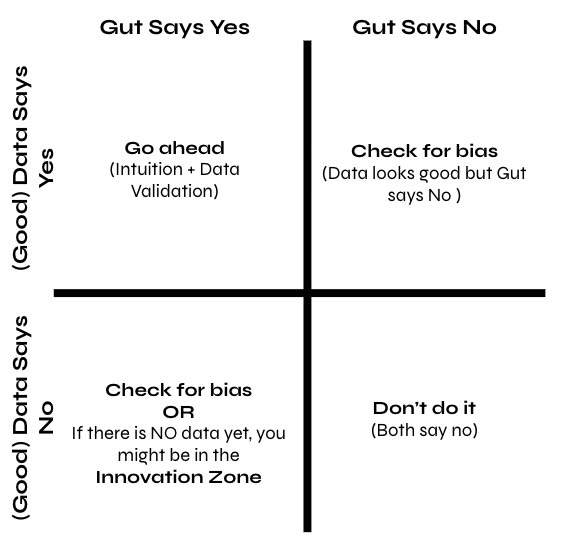
Gut yes, data yes. Proceed. This is alignment, and it is rarer than you would like. Enjoy it.
Gut no, data no. Do not proceed. This is clarity, and it is worth celebrating for the time, budget and arguments it saves you.
Gut no, data yes. Pause. This is where bias hides. Ask what is sitting underneath the resistance. A genuine signal, or an old story wearing the costume of one? This is the quadrant where strong-willed leaders who happen to be good storytellers do the most damage, because they can talk themselves, and their boards, out of the evidence.
Gut yes, data no. Caution again, with one exception. If the data says no because there is no data yet, no precedent, no comparable case anywhere, you may be standing in the innovation zone. This is where Airbnb and Netflix were born, and where Opnuu lived. It demands discipline: validate fast, hunt for disconfirming evidence, and understand exactly why your instinct fires before you bet the house on it.
The word that fixed it.
The grid had a flaw I could not see until Marco Iannone, Chief AI Officer at Virgin Active, said a single word on a call as we revised the model together. Good.
Not “what does the data say” but what does the good data say. The version that is current, complete, and actually measuring the thing you think it is measuring. Half my “data says yes” readings had been resting on data that was none of those. A confident number from a stale or partial source is not a green light. That one qualifier changed how I use the grid more than anything else.
The map I found already drawn.
I built this grid from my own scar tissue, so I was startled to later discover a similar four-quadrant structure in Eugene Sadler-Smith’s Trust Your Gut, a traffic-light model he attributes to the Care Quality Commission’s thinking on the role of intuition in professional judgement. This time a traffic light sistem. Almost the same four verdicts. Red, avoid. Amber, check your data. Amber, stress test your intuition. Green, proceed.
A healthcare regulator and a tech CEO arriving independently at the same map is the strongest sign I have that the structure is sound rather than personal. And tellingly, their 'check your data' amber says exactly what Marco's one word says. When the gut resists what the numbers claim, interrogate the numbers before you trust them. If the numbers hold up, interrogate your biases.
Where AI changes the grid.
The grid assumes you have data worth weighing. Often, as I did with Opnuu in 2010, you do not, or you cannot gather it at the scale and speed a decision needs. This is where assisted intelligence earns its place. Never to make the call, but to fill the data axis honestly, fairly completely, and with enough rigour to be genuinely useful. It can pressure-test a market-readiness assumption in an afternoon that would once have needed a research budget I did not have. It can hunt for the disconfirming evidence your own confirmation bias is quietly steering you around.
Used well, it strengthens the very axis Marco told me to improve.
What this means for you this week.
Take one decision you are sitting with now and place it on the grid. What does your intuition say, what does the good data say, and which of the four squares are you standing in?
If you are in a green or a red, act, and trust the time it saves you. If you are in an amber, the grid has done its job. It has told you precisely where the remaining work is: interrogate the data, or interrogate you. Know which question you still owe yourself before you decide.
What is coming next.
Over the next couple of weeks, a few short, science-backed pieces on how to create the optimal conditions for your intuitive signals to make themselves heard. We cannot switch intuition on at will, but there are small, practical things that make the quiet signals more likely to show up.
And if you would like to say hello in person, I am chairing the AI and Innovation stage at MAD//Fest London from 7 to 9 July at the Old Truman Brewery. Come and find me and stay tunes for a miniseries on intuition, data and AI working together I will write straight after the event.
So here is the deal. Your intuition will not come when called, but you can lay out everything it likes, the rest, the walk, the quiet, and wait. And while you wait, check your data, so that when the signal does turn up, it is meeting something definitely good.
If you found this useful, share it with someone about to bet the house on a hunch, or the one who insists the spreadsheet is always right, two ends of the same spectrum, both of whom could do with listening to the input they keep ignoring.
If you are not yet following Intuition Edge, you can do that here:
substack.com/@intuitionedge
Published every Monday.
Always a great read... you got me thinking about something - and a good "zeitgeist" tie in that your writings could pair with....
Spider man - A brand new day.... Spiderman's main super power (apart from the webs) is his "spidey sense" his innate intuition... when he can "feel something is wrong"
I reckon you should get in touch with whoever doing the marketing and offer to interview the cast about their real "intuition edge" moments.
xx