

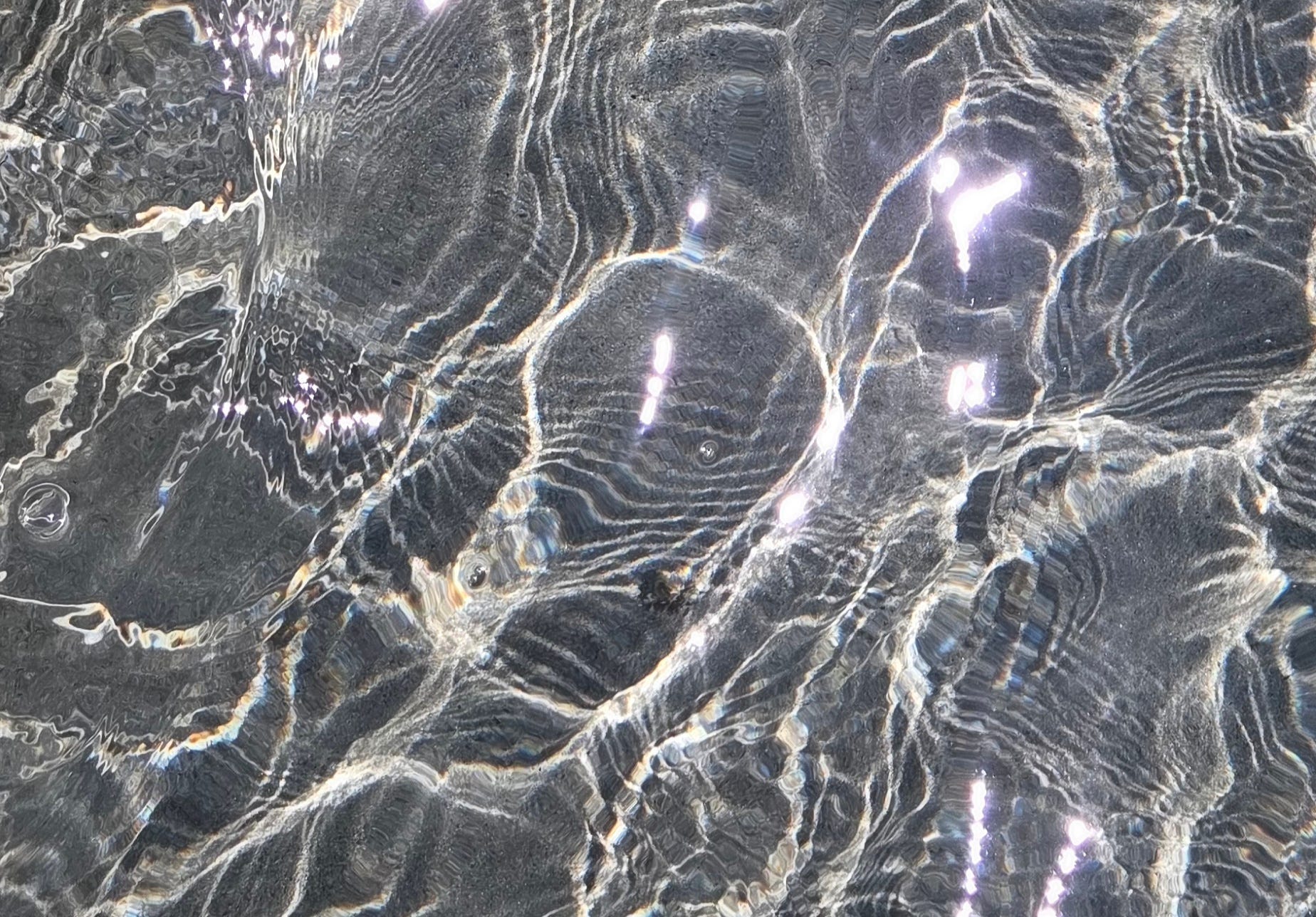
“You’re on your way to a heart attack by age 50,” he said, when I was 39. “Or you might live to 100, if you take five minutes every day to do what you just did here today.” These were the words of a highly experienced Scottish doctor, at one of those two-day executive health checks my old company sent me for, the kind that measures everything, a scheme belonging to a time not too long ago when those things existed for employees.
Here I was, a woman in her late thirties, living sensibly, healthy in every measurable way, and yet my stress markers were off the chart. He was visibly cross at the colours from the readout in front of him, offered by a machine measuring my heart rate variability. The chart showed far too much red, a lot of blue, and just a little green.
I had no clue you could actually see stress back then, and I was fascinated, thinking all the while that today was a good day on top. My body had been keeping a record I knew nothing about, now laid out in colour for me to see on a screen.
This is the same physiology I wrote about a few weeks ago in the heart piece. Back then it was John Coates talking about heart rate variability and how this affected the best traders on the floor. Here it was me, a chart, and a slightly scolding Scotsman.
He asked me to retake the test. This time he told me to breathe in for five, out for five. Close my eyes and picture something nice. Then he left the room and said he would be back in five.
I did as I was told. I breathed. I closed my eyes. And after maybe a minute, my mind went somewhere I did not expect and have never quite been able to explain. A dark space, scattered with points of light, waves and tiny sounds, where the only task was to resist the pull to decide there was an up or a down, a left or a right, and instead to stay merged and dispersed in all of it. When I later described this to my husband he was quite disbelieving and fairly annoyed, on the grounds that I had reached this state without the assistance of mushrooms, which he felt was somehow unfair.
The doctor came back and was startled. The chart was now around 95 percent green, with a thread of blue. A completely different picture from the one he had left. He told me, with a clinician’s flourish rather than a statistician’s precision, that he had rarely seen anyone move that far that fast, and put me somewhere in the top couple of percent he had ever tested. To live to a hundred, he said, I simply had to sit with myself for five minutes a day and recreate what I had just done.
I want to pause here, because I am aware of how this reads. It is genuinely difficult to write about scoring 95 percent green and being told you are built to last without the entire room quietly hoping you trip on the way out. We do not warm to the person who turns out to be top of the class at the one thing they were not even trying at. I thought about softening it, or leaving it out. But the whole point of this piece lives in what happened next, and the relatable part was never the gift. We all have different ones. It was that I had this specific gift, and the proof, and the prescription, and I still could not do the one thing I had just been told would change my life. Even with two young daughters and a husband I deeply love, and every reason to want to be healthy, over and above my own deep love of life - even when it is less than perfect.
So I am telling it straight. Choosing honesty over likability here. Because what came next is not really a story about meditation. It is a story about how the answers we cannot reach finally arrive.
Meditation Attempts, Pathetic At Best
I signed up for meditation classes. I hated every second of them. I did not keep it up, and not just for a few weeks but for four years.
It did not matter how much I understood the science. It did not matter how many times I picked up James Clear’s Atomic Habits, or how many expert friends I asked for help. It did not work, because I did not do it.
When I knew I was about to leave my job, I arranged the same full health check again to make the most of a benefit I almost forgot I had. Same company, different doctor. This time a practitioner in her mid-twenties. She found me slightly dehydrated and otherwise much as before. Excellent across the board, stress markers alarming.
She asked me to retake the stress test, breathing five in and five out for five minutes. But she did not ask me to close my eyes. She did not tell me to picture anything. And she stayed in the room. The result improved, by perhaps ten or fifteen percent, but nothing like the transformation of years before.
I got curious. I asked whether she would let me do it once more, this time properly alone, eyes closed, for the full five minutes. She agreed and left. When she came back she was visibly shaken. The chart was entirely green. She said she had never seen anything like it. Which, I suspect, says more about how early she was in her career than about me, but the point stands. Given the right conditions, my body did the thing instantly and apparently very well.
So now I knew it twice over. No excuse left. If I wanted to be well, I simply had to find five minutes each day. And for another year after that, I read, enquired, and wasted money on a pay-as-you-go set of meditation classes I did not attend, spending most of my time feeling guilty about my failures. Full awareness, zero change. It is a particular kind of frustration, knowing exactly what would help, feeling lucky to be able to do something you have been told is quite hard, and watching yourself not do it, week after week. It is like knowing you are going to win the lottery for sure and finding excuses not to buy a ticket. I felt like a real idiot.
Why Nothing Was Happening, And Everything Was
Here is the part I did not understand at the time, and only understood later through the science.
As I thought I was going nowhere, I was in fact subconsciously accumulating hints, cues and suggestions that would later help me solve the “why am I not making time to meditate to feel better” problem.
There is a mechanism behind the eureka moment, the answer that arrives unbidden in the shower or on a walk, and it was given its fullest recent description in a 2025 paper in Communications Biology by Steven Kotler, Karl Friston and colleagues. Brace for it, as it is by far my favourite piece of learning this year, even if I had to read the paper three times to fully get it.
Opportunistic Assimilation
When you hold an unresolved problem, your brain does not file it away and stop. It keeps it quietly active in the background while you seemingly forget about it and get on with your life, yet it uses that open question as a filter, scanning everything you subsequently encounter for anything that might resolve it. The problem recruits new information, continuously and below the threshold of awareness, until enough of the right pieces assemble for the answer to surface as our beloved metaphorical light bulb.
The crucial detail is that the answer is rarely new information but rather a new arrangement. The pieces were mostly there already and what was missing was the configuration and, most crucially in my view, the readiness to receive it.
My year of guilt and reading and asking was the background process running. I just could not see it working, because by definition you cannot. The surface is clear. The depth is doing the work.
A Friend, Emotions And A Beach
It resolved on a beach, late in the evening, in June. As we were pouring our hearts out to each other, each with our own particular messes to deal with, my wise friend Alex asked me a simple, direct question:
“Are you sure you want to get better?”
It landed like a punch to the stomach. One of the key somatic signals I have spent this whole series describing, arriving with utmost clarity before I could engage anything else. I knew immediately she was right. I just could not see how, because it made no sense to the pragmatic, optimistic, make-the-most-of-it version of myself I thought I fully was.
I had two daughters I adored, both being affected, especially the youngest one, by my high stress levels due to a horrible exit from a company I was going through. If you are senior enough you have most likely had one of those exits too. As my mentor Peter Slator reassured me at the time, let us stop the LinkedIn veneer that those things never happen, or when they do they cannot ever be mentioned. But what is actually important to this story is that I was not using everything I had to get better and manage this incredibly stressful period of my life. For me, for them, and especially for the youngest one.
Here is the detail that matters most for the mechanism. A couple of months earlier, someone I had only just met that evening, someone I felt comfortable enough to speak openly with, had asked me almost exactly the same question. And it had slid straight off me. I had genuinely forgotten it had been said until this other, newer friend reminded me much later. By June, on the beach, with a year of background processing behind me, I was finally ready to receive it, from someone I trusted as a long-standing friend with whom I had spent a great deal of professional and family time. She was almost my boss for a moment, years before, but that is a story for another time. The information had not changed. I had. The signal needed the right conditions and a mind that had accumulated enough to catch it, which is precisely what opportunistic assimilation does.
The revelation itself did not arrive in the conversation but the next morning, as I woke, which is the second classic marker of this mechanism. The conversation seeded it. Sleep assembled it.
A Bag Full Of Daddy Issues, Unresolved
What did surface? As a teenager I had needed to believe my father loved me, even though he never did the things I thought he could have done to get himself better. For me.
I had been quietly proving that case for years by repeating it, declining to get well myself while loving my own two daughters completely. It was me saying to my thirteen-year-old self, look, your father loved you, you love your daughters and yet you are not getting better either, you see? Loving was not in question, it hardly ever is. The reassurance that thirteen-year-old needed, in facts rather than words, was.
I will leave the full shape of that where it belongs, which is not here. But the moment I saw it, the resistance that four years of evidence and a year of effort had not touched simply dissolved. What surfaced, more clearly than anything else, was a loud “Fuck that!”
I have meditated almost every day since.
Where AI Actually Fits
AI can ask a sharp question, sharp enough to land somatically. This is part of what I train individuals and teams to do, respond to those sharp questions when they arrive. No surprise, then, that its use for emotional support has risen dramatically in 2026.
The slow work that makes you ready to receive the answer is yours and yours alone, as AI cannot hold your problem open for a year while you live your life. It cannot accumulate inside you. It could not have been Alex on the beach. Not because of what she said but because of who she had been to me for years before. The relational and temporal substrate that opportunistic assimilation runs on is not something AI enters. The work was human, embodied, temporal, partly unconscious, and partly relational, and there is no prompt for any of it.
AI did, however, do something else genuinely useful for me. As I train companies and teams on how to use intuition to engage AI better, I always promote meditation as a practice that quietens the noise so you can better hear the signals. I am not an expert in meditation and I often got asked what type of meditation I practiced. I did not know as I had no clue what it was. I wish I could have said 'Transcendental.' Easier to get and hugely fashionable. Instead, I simply went to that dark space full of wavering light and tiny sounds and stayed there, merged with it all.
So I described the experience to ChatGPT, as plainly as I could, and answered a few questions posed by the algorithm.
It told me I appeared to have arrived, on my own, at a hybrid of open awareness meditation, non-dual practice, and formless absorption, with the closest traditional parallels being Dzogchen and Mahamudra, and some overlap with the formless states described in certain Buddhist traditions, particularly those concerned with infinite space and infinite consciousness. It noted, more strikingly, that I seemed unusually sensitive to the constructed nature of spatial orientation and the division between self and other, perceiving their assembly and disassembly directly rather than understanding them as concepts, and that this was relatively uncommon. Please do not ask me again in a keynote or workshop session, as I cannot even pronounce Dzogchen and Mahamudra, but I am glad I now have the answer.
I had reached the destination with no map. The machine handed me the name of the country.
The temporal, embodied, relational work of a human life is not something AI competes with, because it cannot enter it. What AI does, superbly, is meet you on the other side and help you understand what you already found.
What To Do With This
The practical payoff is uncomfortable, so I will state it plainly.
Awareness is not readiness. Knowing what would help you, even knowing it with biometric certainty, does not move you.
You cannot force the eureka moment, nor know for certain what it will deliver when it arrives, but you can build the conditions that invite both. Hold the real question, not the convenient version of it. Allow the background process to deliver. Sleep on it. Have a conversation about something else. And stay genuinely open to the people slightly outside your problem, because the person who asks you the question that unlocks everything is rarely the expert and rarely on the second attempt.
The most important question anyone asks you may be one you are not yet ready to hear. You may need to hear it twice, from two different people, a couple of months apart, before it lands. And that is the mechanism working. Your job is to keep yourself in the rooms and the conversations where the right question might get asked again. Eventually you will have accumulated enough for the bulb to light.
I had the proof for five years before I changed. And the proof was not enough. But a question on a beach was.
Writing this took more out of me than I expected. So just this once, an affectionate nod to three people who made it possible. Alex Dimiziani, for asking the question. Dr. Peter Houghs, for giving me the courage to write this piece, and for handing me my next unresolved problem to sit with. And Rick Rubin, for being my favourite read when meditation and creativity are at play.
What Is Coming Next
Next week we move from the individual to the collective. Why a group can sense things no single person in it can, why genuinely diverse teams read a situation more accurately than brilliant individuals working alone, and where AI fits as the newest participant in collective sense making.
If this resonates, share it with someone who knows exactly what would help them and has not managed to do it yet. They are not failing, even if they know Atomic Habits by heart. They may simply not have heard the right question, from the right person, at the right time, just yet.
If you are not yet following Intuition Edge, you can do that here: substack.com/@intuitionedge
Published every Monday.
what stood out to me the most was how 5 min of breathing was all it took to change your entire chart green. Isn't it interesting how many of the systems in the world (e.g. meditation retreats) make us think it is what we need to get better when the solution to our problems is far simpler than we think? loved reading this :)
Your piece resonated with me because it touches on something I've been thinking about a lot lately, although I've come to somewhat different conclusions. I found your idea that answers take shape in the background before becoming available to us particularly compelling. At the same time, my sense is that regular practice often changes our beliefs gradually, rather than the other way around. Insight can be very helpful, but it isn't always necessary for change to happen.