

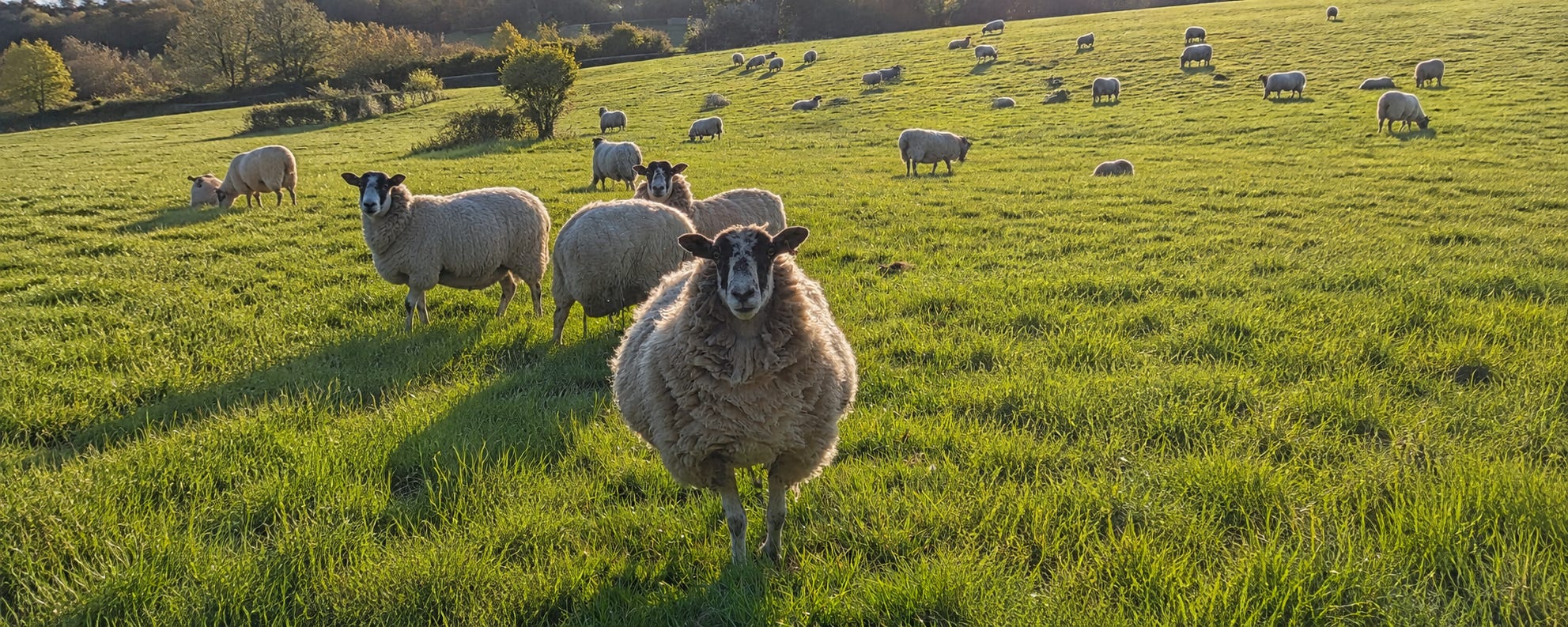
Please allow me to start with a little disclaimer. The sheep you are looking at has no role to play for about six hundred words or so, but when her moment comes it is a key one, which is why I chose her as the header. Please bear with me.
The inspiration for the last piece, this one, and the one coming next all started while I was at MAD//Fest last month, when someone in the AI and Innovation stage audience raised a hand and asked a question that I felt was a little under answered and not given the full response it deserved. As I was the Chair of that stage, and time keeping was among my duties, I did not linger and I let the conversation move on rather than pausing, yet the question kept bugging me.
More or less, the question was this. I am advising a client, he is making ads independently with Claude, they are not that great, and he does not want to listen to me even though he hired me as the expert to guide him.
Your question carried a lot of depth, and yes, it made me think about the IKEA effect I covered in last week’s piece, which answers the first part of it. Why does your client think his work is better than it is. The second part, which is just as interesting, went unanswered. Why does he not listen to you, given that he hired you to advise him.
Maybe he was a victim of the IKEA effect. Or maybe he thought the consultant was biased, which is the very reason she deserved to be hired in the first place.
Bias As An Asset
Nobody is independent or unbiased, and that is a good thing when it is actively used, as I covered in The Filter Nobody Told You About. We are the product of our experiences and we look at the world through the tinted glasses of wherever we focus our attention, as well as the goals we are given or set ourselves inside the organisation we serve. Our wishes, desires and fears often run us, and while a good deal of self discipline can at least make us more aware of them, nothing beats a well curated team that pulls in different directions because it is differently biased. AI is one member of that team. The secret sauce is how you curate who is in the room, and the space and the rules you give them, and it, to interact.
And there is nothing worse in my view than group bias. As Kahneman, Sibony and Sunstein knowledgeably point out, while averaging opinions removes the scatter between them, it does nothing at all to a bias they share. If you ask ten people to guess the weight of a sheep they will come up with random guesses, and the average will be more or less right. Now show them the sheep at the top of this piece, photographed head on, in low evening light, standing rather closer to the lens than the rest of the flock and every one of them will most likely guess high, so the average of ten high guesses will simply be a higher overall guess. In their book Noise they use a cow, but you get the gist.
This is what you get when five CMOs in the same sector, all reading the same newsletters and all measured on the same quarterly numbers, get to debate something. They will most likely agree with each other, at best bringing some tricks and tools and shared personal experience as added value to the conversation, and real innovation is unlikely to happen because they will tend to confirm what they more or less already knew. AI is the worst of the lot on this, because what it hands back is roughly the consensus of everything already written on the subject.
Your Secret Sauce Is You
Even maths proves it, as Scott Page showed that a group’s collective prediction error equals the average individual error minus the diversity of their estimates, which he calls the Diversity Prediction Theorem. In layman’s terms, collective accuracy rises because people think differently, even when no single person in the group improves their own reasoning or expertise.
His caveat is that this only holds inside a shared base of relevant competence, and outside it what you have is noise rather than signal. Or in other words, you would not invite a skateboarder into a brainstorm aimed at working out whether the Higgs boson can explain the matter-antimatter asymmetry in the universe. Unless the skateboarder is also a physicist, of course. All explained in Your Best Career Hack Is The Collective.
So Where Does That Leave You
Try to assess with some level of lucidity where your competence really lies. You can use my diagram here, which was inspired by something Warren Buffett popularised, so trust that it is at least half good. Then ask a few friends or colleagues to tell you what they think of your core abilities. I tend to pick four, two who have known me for a long time and two who are relatively recent acquaintances, and more on why later. All four share enough language and domain competence to understand what they are looking at, while bringing slightly adjacent and different skillsets, so that each of them sees something the others do not.
Beauty is in the eye of the beholder, and it is rather nice to find out what people see in you that you could not see yourself, provided you encourage radical candour from them and receive what comes back with radical open-mindedness. The test for assessing your own baseline on that is in When Did You Last Change Your Mind On Purpose?.
Then curate the group itself, because knowing where its boundary sits is what tells you whether its disagreement is going to be additive.
How Few, And In What Order
Do we need to keep asking an infinite number of relevant opinions? As I said, I tend to ask no more than four people, and I was thrilled to discover much later in life that there might be some science behind it. Bock, in Work Rules!, describes how in Google’s interview process four interviewers get it right about eighty-six per cent of the time, and every interviewer after that adds roughly one per cent of precision. Four kept apart beats sixteen more, and that is assuming the four reach the decision as a committee. Anything beyond it is not worth the time of the interviewers, let alone the interviewee.
What This Means For You This Week
Count how many of the people you routinely ask are wrong in the same direction as you. Then, next time you are unsure, ask four colleagues and friends. AI can be one of them, and not the main one, and certainly not the only one. Although without AI I would not have been able to generate the extra grass and flock that made my picture, originally shot in portrait, work as a landscape header on Substack.
What’s Next
This was heading for three thousand words, which felt like a lot to ask of anybody in August, so I have kept it to a size you can read between the beach and the second iced coffee of the day. Next week, what I did promise last: how I use AI as one member of a curated team and how to make our biases an asset in practice rather than in theory.
Published every Monday.
I remember reading Rebel ideas and having it speak about group bias and how bringing the right team together will always lower the chance of bias and create a better output. Love this series. Thanks for sending through and looking forward to the next article already