

It took less than three weeks to get my “you were right” out of my committed city-slicker husband, after I finally convinced him to move the family to the countryside.
Our life in London had been a privileged one. We lived a minute from one of the city’s greatest parks, and our flat had a couple of terraces I had turned into small jungles. We moved to a house at the back of a forest, with majestic beech trees. He was unsure at first and won over in days – the branches did it.
Last week I wrote about the possum who taught me to leave my desk, and about the incubation effect, the reason a stuck mind solves a problem best when you stop staring at it.
Then I spent three enjoyable days chairing the AI and Innovation stage at MAD//Fest London, where I opened with a keynote on training your intuition to make better decisions in the age of AI, and where a speaker I will come back to, gave a brilliant talk based on the book that runs underneath this piece.
Whilst last week was about the pause, this one focuses on what to look at once you have taken it.
We are all just trying to get home.
We build gardens for the same reason we drift towards windows. It is longing for the conditions we evolved in and left behind.
Annie Murphy Paul’s The Extended Mind is one of the most elegant books I have read on this subject in years, and it makes an observation I have not been able to shake. She describes landowners in the parched American southwest irrigating their properties until they resemble lush grassland, and gardeners in Japan pruning their trees so the boughs take on the spreading shape of an East African canopy.
These people are not following independent trends or stylistic choices but are chasing what the biologist Gordon Orians calls the “ghosts of environments past”.
We long to return to, or in this case recreate, the places that once kept us safe. Which is why, when we are stressed or agitated or stuck, we so often find ourselves walking towards a park, a hill or the sea without quite deciding to. We seek solace in nature, and nature repays the courtesy of the visit by deeply regulating us.
What the research actually shows.
Gregory Bratman at Stanford found that a ninety-minute walk in nature reduced rumination, that grinding loop of negative self-focused thought, in a way an equivalent walk beside traffic did not.
Marc Berman at the University of Chicago found that people who walked for under an hour through a leafy park performed 20% better on a test of working memory, compared to those who did the same walk alongside busy city roads.
People who have spent time in nature also catch more errors when proofreading, and answer faster and more accurately under cognitive pressure.
Which brings me to fractals.
The geometry your nervous system likes.
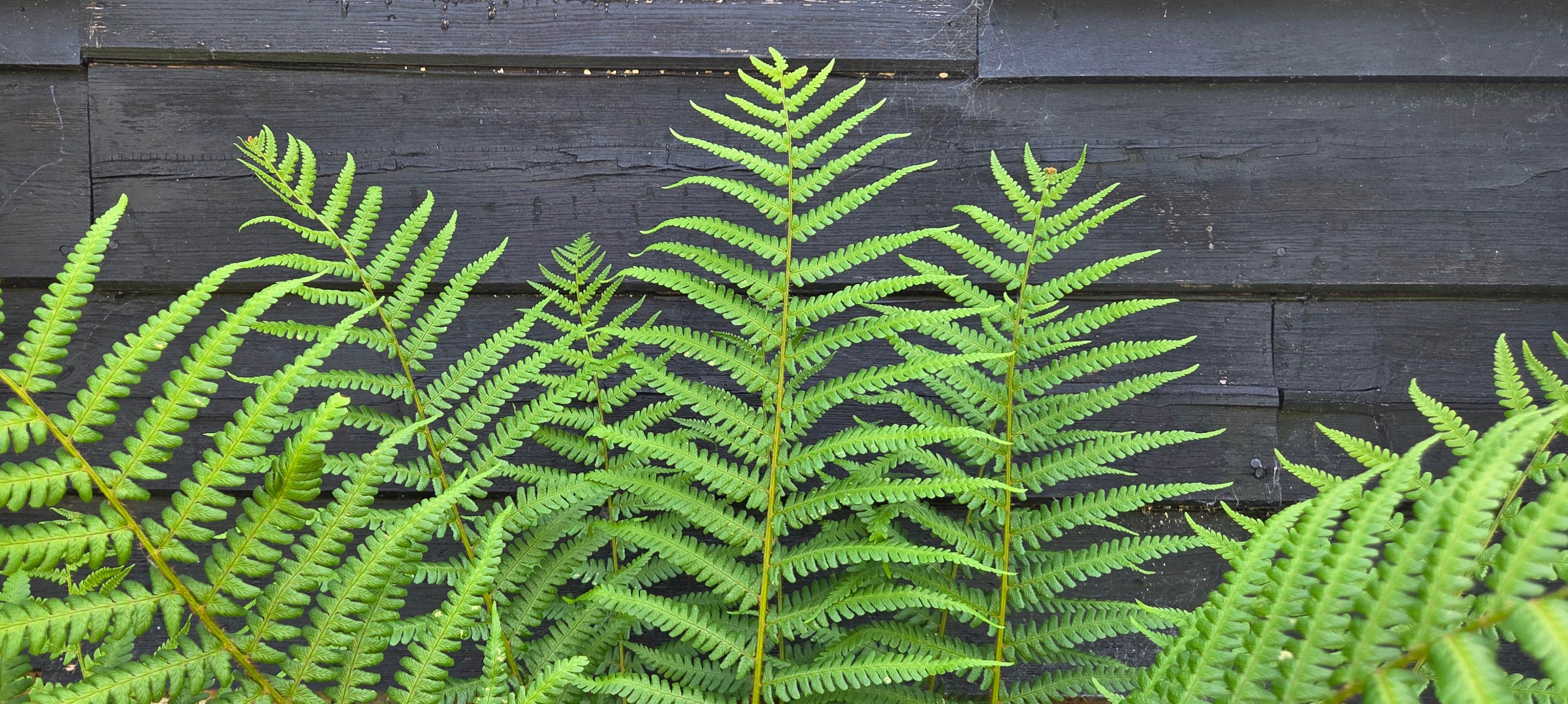
There are many fractals in nature, patterns that repeat themselves at every scale, so that the smallest part echoes the whole, a snowflake, a pinecone, a shell. A fern is the clearest example you will ever find, which is why one sits at the top of this piece. Yet so are coastlines, branching trees, clouds, and so the list goes on.
Mathematicians measure fractal complexity on a scale from one to three. Most of nature’s fractals sit between 1.3 and 1.5, and it turns out that human brains prefer precisely that band, intricate enough to hold the eye, simple enough to require no concentration. The physicist Richard Taylor has spent years demonstrating that looking at fractals in this range measurably lowers stress and restores tired attention.
No surprise, then, that when the adult colouring craze took hold a decade or so ago, several million stressed adults, given every possible subject, chose to spend their evenings shading in repeating botanical patterns.
Whether this was the fractals working on them or just the soothing effect of staying inside the lines, the research has not settled. It has, however, settled that they did not choose to colour in spreadsheets.
And this is what your screen cannot do. A screen is a machine for extracting attention, however restful its contents seem. A fern gives it back.
You do not need a forest.
I now live at the edge of one, which makes me the wrong person to tell you that you do not need it. Yet I can promise you that this mechanism does not care about acreage, just about having somewhere gentle for your eyes to land.
A balcony, a single street tree, a city park you cut through on the way to the station. They all do the trick. Or a plant sitting close enough to your desk that when you look up from the screen your eyes land on something that returns your attention rather than spending it, that does it too, for about five pounds.
Where AI does not belong, again.
That speaker was Alec, and he came at all of this from the opposite direction.
I had argued from the stage that intuition is a capacity you have to train, and that we will need assisted judgement alongside assisted intelligence. A few hours later Alec asked what we lose when the machine starts doing our thinking for us. Cognitive offloading, synthetic empathy, the quiet erosion of human judgement.
We found we had read many of the same books, The Extended Mind among them, and had arrived in the same place from different directions. He was asking what depletes our judgement as I had started from what restores it. The answers turn out to be many of the same, and I suspect I will be seeing a good deal more of Alec.
So here is the provocation. Talk to a plant more often than you talk to Claude. Not because the tools are useless, they are extraordinary, and I will spend the coming weeks writing about them. But when your attention is spent and your thinking has gone flat, the answer is not another tab or another prompt. It is to look at something that costs you nothing to look at, until the tank refills and you can think again.
What this means for you this week.
Put something green within the eyeline of where you work, for the moment when your eyes lift from the screen and need somewhere to rest that is not another screen.
Then, once a day, let them arrive there and leave them for a full minute. No podcast, no phone, no purpose. Just be.
What’s next?
Next week I turn back to AI properly. I heard too many good speakers and saw too many good tools at MAD//Fest not to pay some of them their due.
If you found this useful, share it with someone whose desk has nothing living on it.
If you are not yet following Intuition Edge, you can do that here: substack.com/@intuitionedge
Published every Monday.