

In 2000 I moved from Rome to Melbourne. Inconveniently, in the middle of my master's degree and a good part-time job, I became convinced within a few months that I had lost my intelligence.
It mattered more than it might have. Work was easy to come by in Australia then, and I had somehow secured a huge job I was truly under-qualified for. I got it on the strength of being hard-working, keen, and conveniently fluent in a couple of European languages, while my English was, let us say, “in progress.” I needed every wit I had to keep it.
I had come from a country where you could still smoke at your desk, in a meeting, in a restaurant, to one where stepping outside to smoke had already become the done thing. And just like that, with the mere act of quitting, all my good ideas seemed to have deserted me. It was obvious: the cigarettes had been making me clever, and quitting had broken the spell. I was doomed.
Except I wasn’t. It just took me embarrassingly long to understand what was actually going on.
My intelligence has not gone with the cigarettes, it had simply removed the ten small excuses a day that used to send me out of the building, away from my desk, away from the problem, to stand under the gum trees doing nothing of any consequence. My eyes would settle on a possum who lived in the branches, not studying him but simply resting somewhere while my mind wandered off entirely. He asked nothing of me. Thank you, fluffy little thing with the huge eyes. And while the two of us sat in that companionable uselessness, the back of my mind quietly got on with the work the front of it had been failing at. I would wander back to my desk and the answer would be there, as though it had let itself in while I was out.
It was never the nicotine but the break. Which meant cigarettes had, as far as I could now tell, no redeeming feature whatsoever. So I did what any newly enlightened person does: I became a born-again anti-smoker of the most insufferable kind, the zeal of the recently converted, someone who has Seen The Light and would like a word with you about it.
The science behind the break.
This turns out to be one of the sturdier findings in the study of how we solve problems.
Psychologists call it the incubation effect: set a problem down and your mind keeps working it in the background while your attention is elsewhere.
The strongest version comes with two conditions, and I find both quietly reassuring.
First, the break should be gently undemanding, a walk, a wander, a stare into the middle distance, rather than another taxing task, because it is the loose, drifting quality of an idle mind that does the work. Second, it helps to know you will come back to the problem. There is a subtle self-reassurance in this, as you are not abandoning the problem or giving up on it, but simply handing it to the quieter part of your mind and stepping out of its way. You are giving your subconscious room to work, and your intuition more chance to show up. No one puts this better than Rick Rubin in his beautifully written The Creative Act: A Way of Being, a long argument for getting out of your own way and letting the work arrive.
I wrote about the deeper mechanism, opportunistic assimilation, when it took me five years to act on a doctor’s advice. The possum version is the same thing, minus the daddy issues.
What did the possum teach me?
That is really all the possum was teaching me, by example. He did nothing, required nothing, produced nothing visible, and was entirely, magnificently fine. It took me a quarter of a century, and a fair amount of reading, to understand he had the right idea.
Where AI does not belong.
A note, since I am about to spend three days chairing the AI and Innovation stage at MAD//Fest. The coming weeks here will be full of AI. This piece, deliberately, is not, and that is the actual tip buried inside it. Part of using these tools well is knowing where they do not belong, and a stuck mind reaching for a better answer is precisely one of those places. Do not open another tab. Leave the screen at the desk. Go and find your possum.
A small confession.
I have not transcended my past. I am still, somewhere underneath, one of you, a smoker who has simply managed to stay quit. The craving never fully leaves; it just learns some manners. So I will not preach, though if you light a Marlboro near me I will quietly, nostalgically, breathe it in. I will only say that the best thing the cigarettes ever gave me turned out to be the one thing I could keep without them. The walk away.
What’s next.
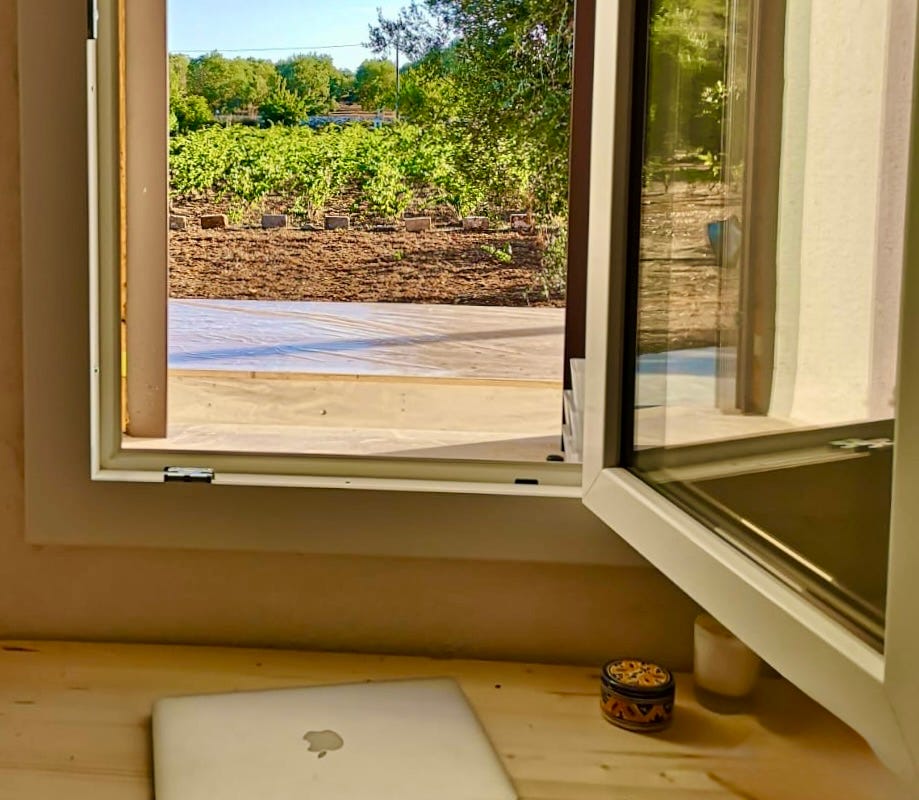
Next week, why where you take that break matters as much as taking it, and why a fern on a windowsill can do what a forest does.
If you are not yet following Intuition Edge, you can do that here: substack.com/@intuitionedge
Published every Monday.
Great article Livia ,it’s left me reflecting long after reading it. The possum is a powerful reminder that our default responses are often adaptive rather than intentional.
It’s the same with leadership and AI, we often optimise for speed when the real advantage comes from questioning assumptions and creating space for deeper thinking.
Love this Livia. My possum is to just walk. It could be a few miles or it could just be around the block, but to step away from the screen and take a different perspective.