

Last week I recommended putting four heads together to solve a problem, and in today’s story there are five in the room, so I believe I need to explain why. In Laszlo Bock’s Work Rules!, four was the ideal number of people to assess the same candidate in an interview, which is a much narrower problem than a strategy workshop. In a workshop each participant usually carries a different part of the problem.
So the optimum number in a room varies according to the problem at hand and the type of company you are solving it for. I believe it was Jeff Bezos who first introduced pizza in relation to management. According to him you had to limit the attendees of a meeting to a size small enough to be fed with two pizzas, roughly five to ten, for a bunch of good reasons such as focus, accountability and speed. I agree with him, even though I think the pizza reference only works in the States. If you are Italian, and Roman as I am, one pizza feeds one person by design because it is a different pizza, so please do not run a ten-person meeting in Rome on classic Roman pizza takeaway or they will starve.
Jokes aside, I did some research and found some interesting numbers floating around. Hackman and Vidmar’s 1970 study in Sociometry points at 4.6 as the ideal number. They also found that size made very little difference to how well the groups actually performed. What the 4.6 really tells you is the point at which people stop complaining about how many, or how few, of them there are. Fewer than four and you do not have enough genuinely different perspectives in the room to be worth debating. But if you get past six, as Hackman himself concluded years later in Leading Teams, the session starts being about the people in it rather than about the work.
It is important to say that the experiment was conducted with students on a fifteen-minute task, so hardly comparable to a strategy workshop. I do still think size matters in a workshop, though what matters far more is who you put in the room, what you tell them and when, and whether the conversation is genuinely happening at group level rather than between two people while everyone else watches.
Five Skilled Practitioners And An AI
The five I am thinking of were sitting round a table with me and an algorithm, and the session had not started, because we were still deciding how to brief the machine. That turned out to be the session. One of them had been feeding it narrow questions and getting narrow answers, having never considered that the framing was the constraint. Another had assumed that brand-sensitive work needed extensive training and careful curation, and had barely used it there at all. A third had not known it could hold an entire technical build plan and help think through the order things needed to happen in. A fourth shared a prompting approach that visibly changed how two people in the room would work from that day on, and the fifth walked everyone through her own method for checking whether an output was valid, which the group adopted on the spot. They had all been using it alone and almost intimately, and building something with it together made that visible in a way solitary use never could.
You Are Not Alone
In my last piece I wrote about the dangers of using AI in an intimate one to one relationship. There are many ways to use AI well, and the most important of them is making sure there is a collective driving towards better, with different biases, the machine’s included, coming together in a well structured session. That is the thing worth curating. You are never alone, even in a CEO job, which is notoriously deemed a lonely one. Well curated co-creation with your team, and now with the AI, is the way forward to better decision making.
The Gains
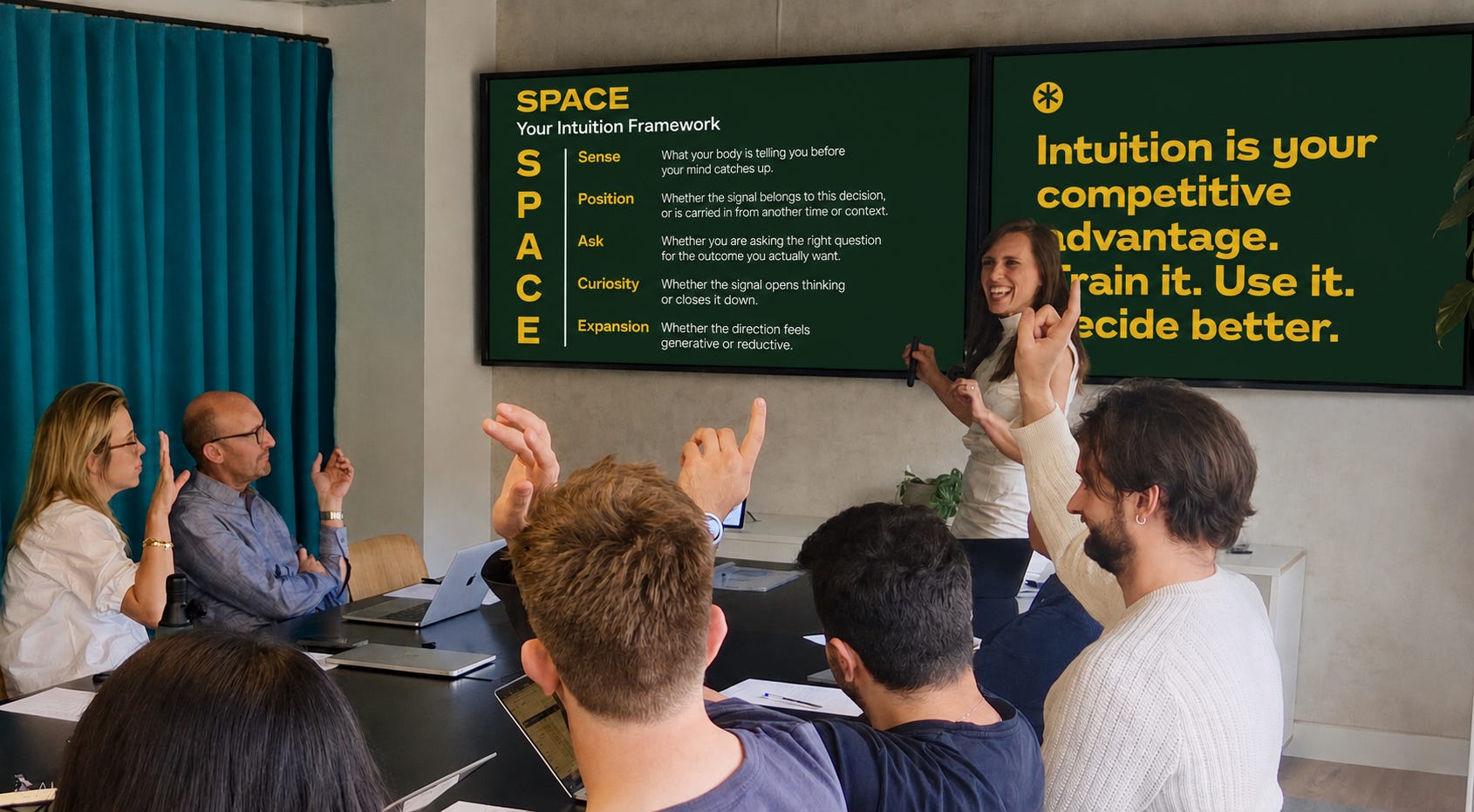
Once you have assembled the right team, the job is to make sure collective intuition is well harnessed and managed. The team’s individual intuitive signals, captured live and verbalised through a shared language, can be collected in a process that creates a safe space and real progression on the task at hand. I call that process SPACE, and these are the five benefits I keep seeing when a room uses it in a structured workshop with corporate teams:
Momentum. People align and decide faster as a team, thanks to a shared language, a process, a safe space and a record of why.
Fewer bad decisions from unchecked AI.
Risks identified earlier, because someone can now safely express what they are sensing, having been given the language for it.
Better accuracy and differentiation. If everyone uses the same tools and writes similar prompts you get a sea of sameness, and curated difference is what counters it.
Clear ownership at board and senior leadership level. People point at the model and accountability moves away from the person. AI is not a cover. Accountability stays with the team using the tool well.
The best prompt needs a good deal of exchange, just as the best AI output needs stress-testing collectively, using each participant's intuitive signalling alongside their professional biases and whatever other data is relevant.
The Collective Can Do What No Individual Can
So if biases are a plus, and problem solving in 2026 is the art of humans and machines coming together, how do we learn to write the best prompts?
Together.
The best prompts are the ones crafted collectively. Keeping the team small and curated around solving a problem from different perspectives, rather than filling a room with people who will tend to agree because they share the same experience, is half the job.
The other half is letting an experienced external moderator guide the conversation, since their biases and viewpoints are usually different from those of everyone employed by the same company.
Disagree About The Work, Never About The Person
When relationships suffer the work suffers with them, and never more so than on complex decisions. Here is the hack. Avoid arguing about who does what and instead argue about how the thing should be done. De Wit, Greer and Jehn reviewed 116 studies across nearly nine thousand groups and found that task conflict only helps when relationship stay healthy.
It comes down to sentences like "You always over-engineer this" or "That's a classic marketing thing to say", which immediately become personal. Instead try phrases like "I read that output differently, and here is where" or "What would have to be true for that to work?", which are about the work. And never feel afraid to ask the team to hold collective judgement open for ten minutes in a world that is pushing us to decide super fast, often prematurely.
Why AI Makes Arguing Well Easier
ChatGPT and Copilot do not care about being promoted or about pleasing one person over another, and they have no reputation or position to defend. Once the prompt and the context have been decided together, nobody in the room solely owns the output either.
In one of the sessions I ran for a global brand I work with, the most interesting finding was accidental. Challenging Claude's output turned out to be easier than openly disagreeing with a colleague, which made it a very effective catalyst for surfacing what the room really thought. It was task conflict with the relationship conflict taken out of it, and a group of people who have just argued with a machine find it considerably easier to argue constructively with each other. Everyone in the session left feeling more necessary than ever, at a time when employees are sabotaging AI implementation initiatives for fear of losing their jobs.
What This Means For You This Week
If you take one thing from this, make it the prompt. Write it with other people, out loud, and expect that to take longer than you think it should. Most of the arguments worth having in a session turn out to be arguments about what you are actually asking, and they surface while you are still deciding what the machine needs to know, do and where it has no saying.
Get someone in from outside if you possibly can. I would say that, since it is what I do for a living, though the reason is genuinely that everybody employed by the same company has been marinating in the same assumptions, culture, category dynamics, and is key to have someone in that room who is alien to that.
Then use SPACE to say out loud what you are sensing, and put it on the table next to the numbers rather than underneath them.
Have fun with it and tell me what worked and what did not. I hope this turns out to be the year AI stops being used as a solo confidante.
What’s Next
Back to nature, and to the way we move, and to the practices that make your own signal more likely to surface in the first place.
If you are not yet following Intuition Edge, you can do that here: substack.com/@intuitionedge
Published every Monday.